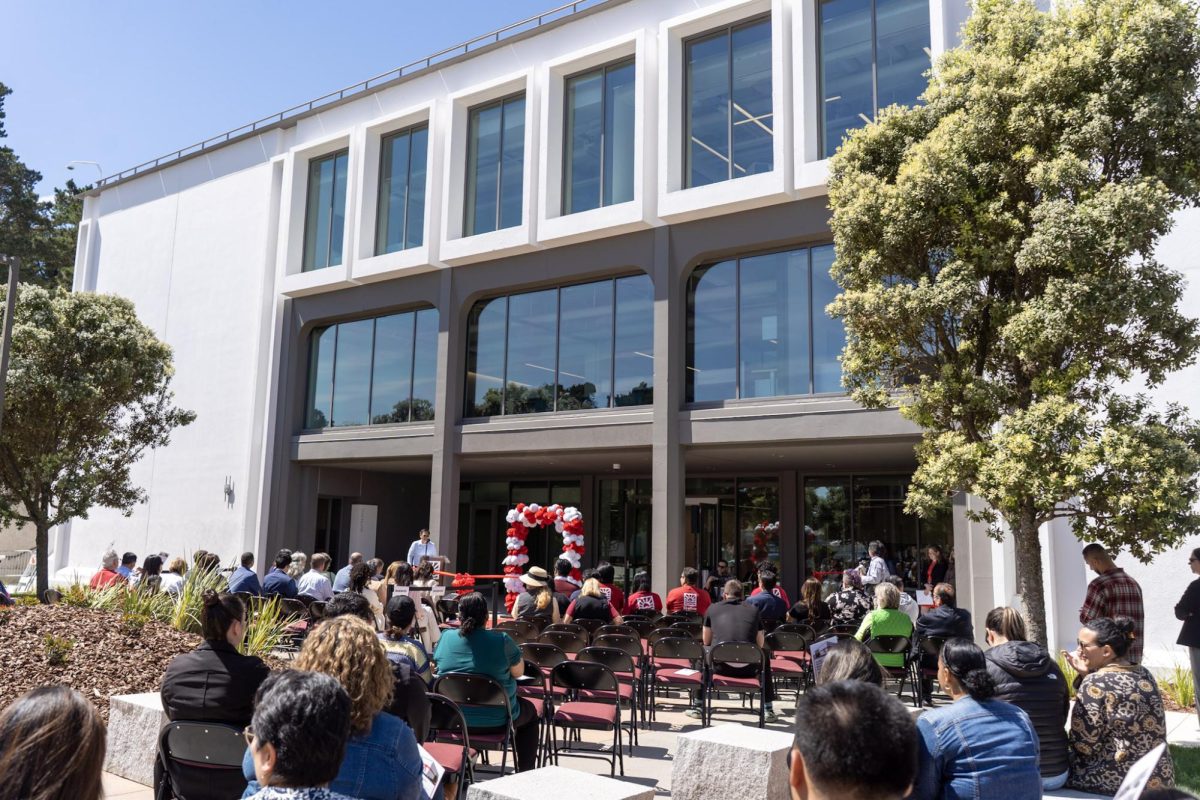


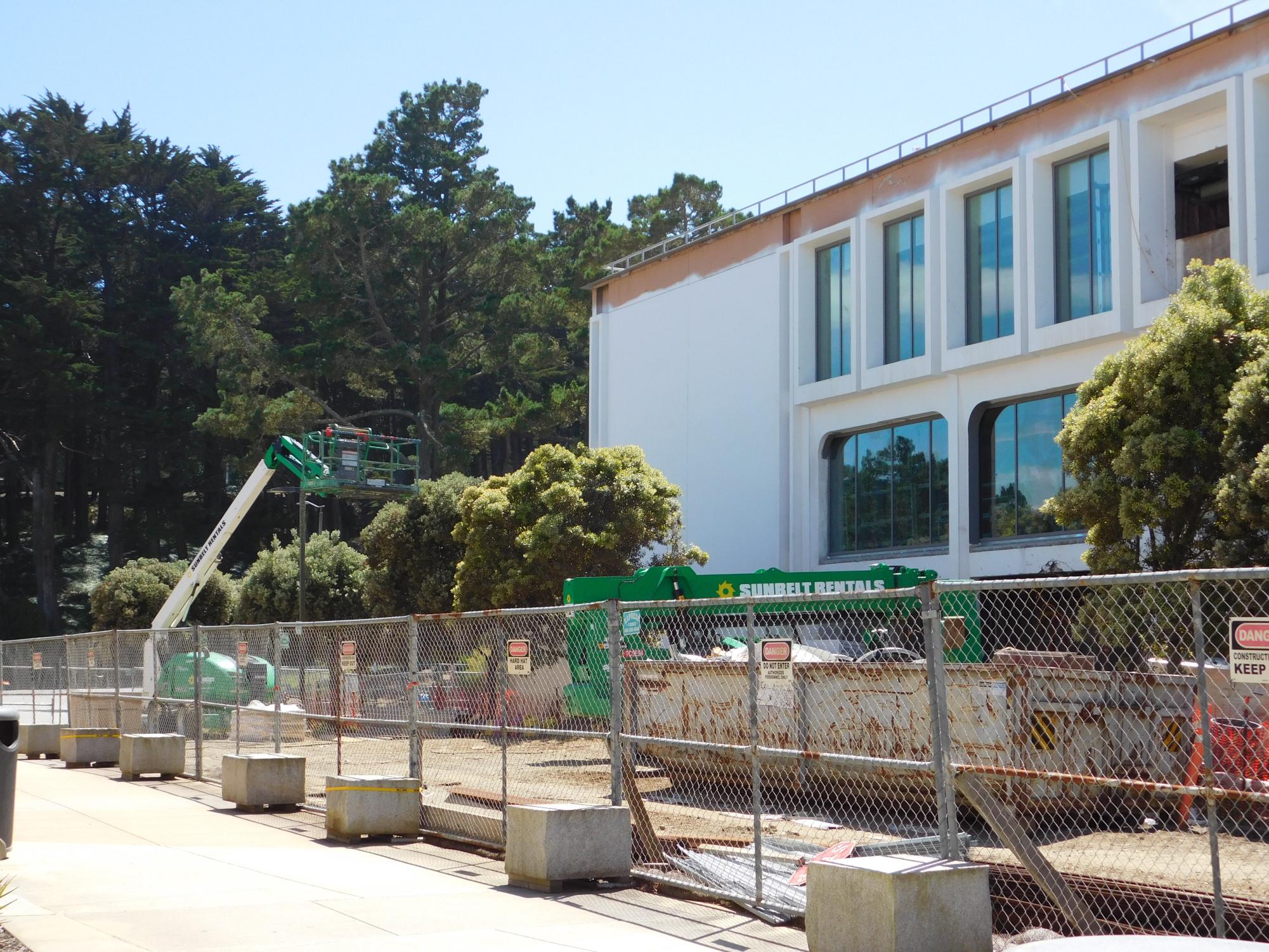
It has been four years since Building 2 began major reconstruction, which used to house Skyline College’s Departments and Student Services. After a long road filled with delays, it seems the project is finally seeing the light at the end of the tunnel, with its completion slated for early next year.
Director of Capital Projects, Marie Mejia, said that the new Building 2 will be a marked improvement over its predecessor in layout and convenience.
“The building was over 50 years old and there were structural issues, and the old building was pretty much a maze,” Mejia said. “So we’ve opened it up to have more departments and be more welcoming, upgrade on technology, and just the overall welcoming feel of the building, especially for new students to come in.”
According to the FY2025-FY2029 Five Year Capital Outlay Plan, the new building will make use of 7,897 square feet of previously unused space and have improved base utilities, including power, lighting, data, security, Heating, Ventilation, and Air Conditioning (HVAC), and plumbing.
Skyline College President, Nathan Carter, also commented specifically on the improvement to data that the building will provide, with it becoming a greater focus for the campus.
“It’s not lost on any of us how sometimes it can be hard to get cell service around here,” Carter said. “The college is working on that here at Skyline to improve cell service inside the building, so that is another focus that deals with some more I.T. aspects that we’re doing, but we should see some improved cell service inside buildings.”
Additionally, Mejia said that she expects student services to be faster and easier to use with the new system coming with the building.
“It’s gonna be a queueless service,” Mejia said. “All the departments in there such as Financial Aid and A&R [Admissions and Records], Transfer Centers, Counseling Services, we’re trying to design a software that’s queueless and it’s an easier process for students to come in and get assistance on what they need.”
However, it hasn’t been an easy job, as Mejia said the project has faced several setbacks and delays over the years, the first of which was getting it permitted in the first place.
“Usually DSA, which is the Division of State Architect, in a building like this would take maybe 8 months to 12 months for permitting, but it was 2 years,” Mejia said. “And on top of that there was Covid, so the permitting agency also tried to figure out how they’re gonna review plans offsite.”
Furthermore, the construction crew had to solve multiple problems as they worked on the old building, having to perform a full seismic retrofit as well as remove asbestos materials.
“That’s why there was a delay in permitting, because of the permitting agency requiring us to do a full seismic,” Mejia said. “We were also uncovering unforeseen conditions; the waterproofings were hot, meaning asbestos, so we had to stop the whole construction site and remove that carefully, and that alone was one or two months.”
That being said, the end of the construction seems to be in sight.
“The schedule right now shows that we’re supposed to do final completion around January, and we have about, I want to say 12 plus departments that need to move in, and 130 people,” Mejia said.
However, as Mejia explains, it’ll take longer to actually move every department in without disrupting the services they provide.
“The challenge is: all of the departments have different schedules that we can disrupt,” Mejia said. “It’s not gonna be a clean ‘we’ll move ‘em in one month,’ so I need to coordinate with different departments on how and when they are available to pack and move. It might take six months for different departments to move, it could be staggered from March to August, or even later next year.”
Carter said he is confident in the positive impact the new building will have on the campus as a whole.
“A lot of our student services footprint will be in this building, and that is so important for students to be able to check in with financial aid and registration, and just walk across a short way to their classes, to see a faculty member, or to get something at the book store,” Carter said. “It’s going to be great, it’s going to be transformational here.”