
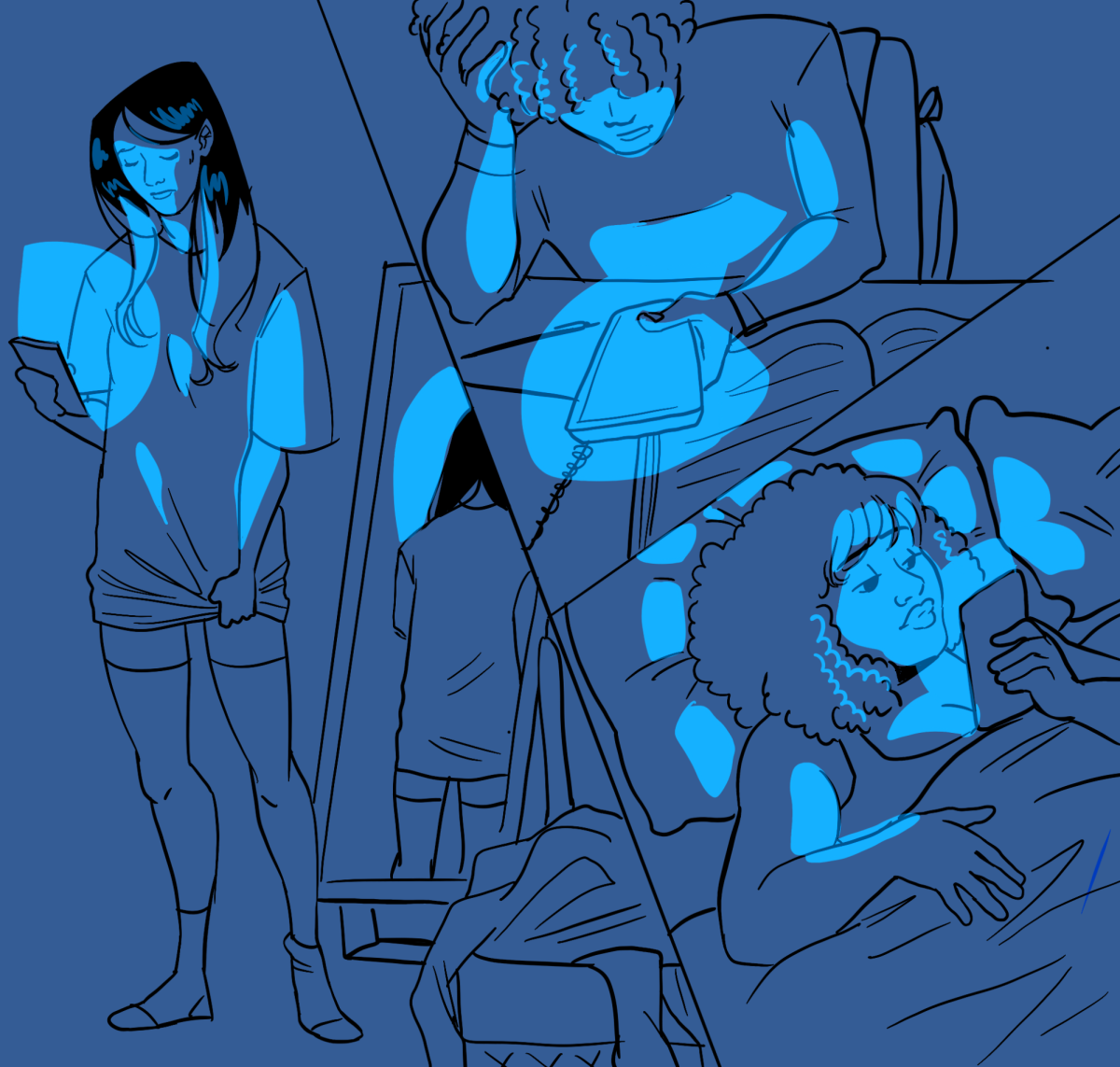
While social media can help people find their interests, it can also become toxic, harming students’ mental health and fostering negativity. Social media’s impact on mental health is a major concern for many students as usage cam lead to issues with attention span, mental health and self-esteem issues, on top of comparison, stress, and time loss.
Perry Chen, a Skyline College personal counselor said, social media takes up people’s time, preventing them from completing their work.
“Some people will talk about it being like a time sink … they’re constantly on their social media feeds, not getting things done,” Chen said.
Chen said people choose what to post online by carefully selecting and curating their content.
“It’s not a real reflection of who everybody is,” Chen said.
Skyline College student Rihanna Ursua said seeing others present themselves sometimes influences her to do the same.
“Sometimes it affects how I present myself,” Ursua said.
Ursua said managing how much time you spend on social media depends on your needs.
“Just manage your time with it,” Ursua said. “If you feel like it’s distracting you or taking away your time, manage your time better with it. If you enjoy it, then be on it.”
Skyline College student Luka Shabatari said social media pressures us to compare ourselves to others.
“It creates unrealistic standards for how your body should look and how much money you should have,” Shabatari said.
Shabatari said that social media can make you stay on longer than you realize.
“Don’t let it consume your life, … you can find yourself on your phone until the end of the day,” Shabatari said.
Cañada College student Dubraska De La Torre felt similarly. She said using social media on a break can turn into excessive consumption.
“You really lose track of time,” De La Torre said. “You’re taking a 10-minute break, and then it turns into two hours.”
De La Torre said she felt constant pressure to post “every single thing” on social media, but realized she needed to stop.
“It doesn’t allow me to enjoy life if I’m constantly doing that,” De La Torre said. “I just wanted to stop, and I did. I feel better, so I stick with Tumblr.”
Pamela Vela de, a recent Cañada College graduate, said social media affects her mental health in how she absorbs information and sees herself.
“It makes me used to short and fast information, rather than just reading something longer,” Vela de said. “Comparing myself to other people and other accomplishments that are posted on social media.”
Vela de said social media is designed to keep people scrolling and to stay on the app longer.
“I believe it’s the way that it was purposely intended,” Vela de said. “To scroll and find out what you like and what you don’t like, … to place things on your page for you.”
Cañada College student Janet Perata said social media affected her high school, but now uses platforms such as Pinterest, Instagram, and TikTok to discover interests and hobbies she enjoys.
”Nowadays it’s more of focusing on ways to use interest,” Perata said. ”To really find hobbies that I like, … explore for myself, not really for anybody else, … for me.”
Perata said she posts to share what feels genuine for her.
“I don’t really post (for) any other people to see, … mainly for my friends,” Perata said. “I only post when I feel like it, …if I really want to share things at the moment.”
Ismail Bellarde, another recent Cañada College graduate, said social media is made for people to compare themselves.
“The whole thing about social media,” said Bellarde, “It’s made so you compare yourself to other people and you feel bad.”
While social media is here to stay, learning how to control consumption can improve your mental health once you no longer care about it.
“Don’t let it get to your head,” Bellarde said. “Once you manage to understand how it does, and you’ve learned that control, … that’s all that matters. You won’t care in the end.”