Lauren Ford, the interim vice president of student services at Skyline College, let clubs know that as college-sanctioned organizations, they are unable to vocalize support for the teacher’s union or any political stance.
Ford said she had to address the situation after it was brought to the district’s attention that clubs were posting flyers around campus that stated their support for the teachers union. Ford described how seeing the flyers lead to a Chancellor’s Cabinet Meeting where it was decided that they “have a responsibility to ensure that students are aware of the various policies and procedures that support and shape our institutional practices.”
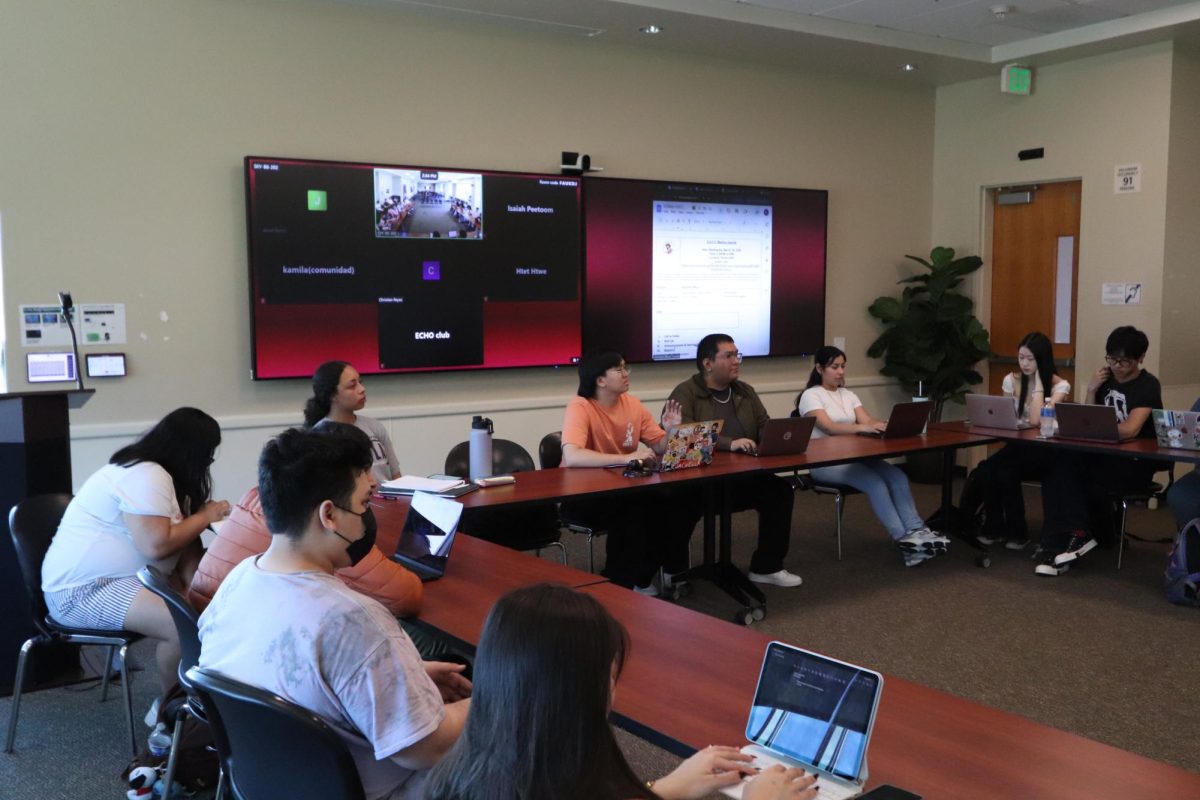
Rachel Cunningham, a professor of geography at Skyline and an AFT union member, spoke out in protest of the district’s decision at the Wednesday, April 8, SOCC meeting.
“What is the point of student clubs?” Cunningham said at the SOCC meeting. “To have fun, yes, to make friends, yes, but also to develop skills…to discuss and sometimes disagree with controversial topics in an effective and educated manner.”
To address Cunningham’s dispute, Ford referenced Board Policy 2.35 Article 8 and 11, which states that “District communications systems may not be used to promote a particular…political position.”
“We can’t, as an entity, support a particular candidate or anything like that, under our college umbrella,” Ford said.
Since the Associated Students of Skyline College is a school channel, not simply a student governing board, they are not allowed to advocate politically. Clubs have the privilege to use the Skyline name and logos, but this use is non-autonomous and under district supervision.
Ford reassured student clubs that so long as they don’t use district communication services, they are still free to advocate for and support what they believe in, but they may not do it under the Skyline name. Ford also mentioned that policy concerns can be raised to ASSC President William Oo and Vice President Jared Morris Ramos, for the District Participatory Governance Council (DPGC) to discuss.
Ramos said he believed that the decision was for the best, and in his time here, something like this has not happened before. At the next meeting, he said he hopes ASSC can “figure out the next steps for us as students.”
There is still hope for students to amend this policy. Board Policy 2.35 Article 12 dictates that “The Chancellor, College Presidents, director of public affairs, and College marketing directors/public information officers may grant exceptions for special circumstances.”
Ford was not able to define exactly what the circumstances could refer to, but perhaps a collective student body calling for legal compliance with the 50% Law could warrant an exception.
As for now, clubs are not able to post messages regarding union activities, in support of any political candidate, or in promotion of any commercial goods. Ford stated, “the College does not intend to seek any punitive actions against student organizations who refuse to remove their current postings”
This action is not meant to limit the students’ individual voices, just the collective voice of a club under the district’s umbrella. Students are urged to express their views and opinions freely, so long as it is not on behalf of the school.